 Racespot
You’re standing at kilometre 30, with a sign and cold hands. Too early, and you wait an hour. Too late, and you’ve missed your runner. Three numbers tell you roughly when your runner will reach you, and a few rules of thumb tell you how much slack to plan in.
The sum
You need: your runner’s pace (minutes per kilometre), the kilometre where you stand and the moment your runner crosses the start mat.
Time to your spot = pace x kilometre. If your runner does 5:30 per kilometre and you’re at kilometre 30, that’s 5.5 x 30 = 165 minutes, so 2 hours 45 minutes after the start mat. If your runner crosses the mat at 9:40, they’ll reach you around 12:25.
Only know the goal time? Divide it by the distance. A 4-hour marathon is 240 minutes divided by 42.2 km, just over 5:41 per kilometre.
Read it off one table
How long after the start mat your runner is where, at an even pace:
| Pace per km | km 10 | km 21.1 | km 30 | km 40 | Finish |
|---|---|---|---|---|---|
| 4:30 | 0:45 | 1:35 | 2:15 | 3:00 | 3:10 |
| 5:00 | 0:50 | 1:45 | 2:30 | 3:20 | 3:31 |
| 5:30 | 0:55 | 1:56 | 2:45 | 3:40 | 3:52 |
| 6:00 | 1:00 | 2:07 | 3:00 | 4:00 | 4:13 |
| 6:30 | 1:05 | 2:17 | 3:15 | 4:20 | 4:34 |
Count from the start mat, not from the starting gun.
The start pen counts too
At big races runners start in pens that go off one after another. If your runner is near the back, they may cross the start mat quite a while after the gun. So don’t just ask what time the race starts, ask when their own pen goes, and add a few minutes for walking up to the mat.
Why it gets later
The table assumes an even pace from start to finish. In real life hardly anyone runs like that.
- The second half is often slower. Especially in a marathon, many runners slow down after about 30 kilometres. If that’s where you stand, plan in more time.
- Drinks stations and crowds cost time. The first kilometres are busy, and every drinks station slows things down a little.
- The watch measures more than the course. If your runner’s watch says 5:30, the pace along the course is often a little slower, because GPS usually measures a bit too much. More on that in Chip time or GPS.
A rule of thumb: be at your spot fifteen minutes before the time in the table, and a bit earlier still after kilometre 30.
Live instead of beforehand
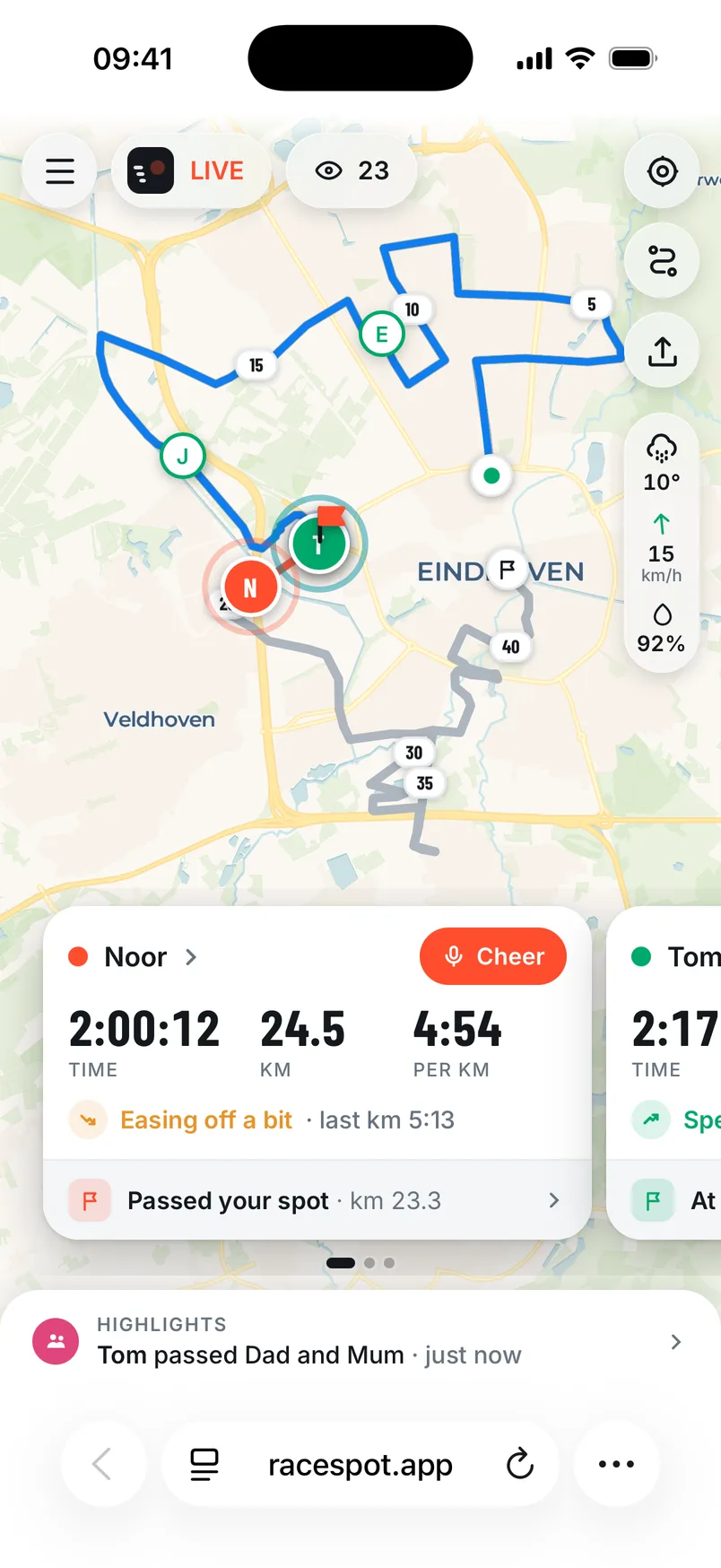
Working it out beforehand is a good start, but on the day you want to know how it’s going right now. For that you need a live track. In Racespot you tap the spot where you’re standing, and you see roughly when your runner will get there, based on the pace so far. If your runner speeds up or slows down, that time moves with it.
At the Eindhoven half marathon we noticed the distance on the phone came out over 3% higher than the course. That’s why Racespot works out the arrival from the position on the course itself, not from the added-up GPS distance.